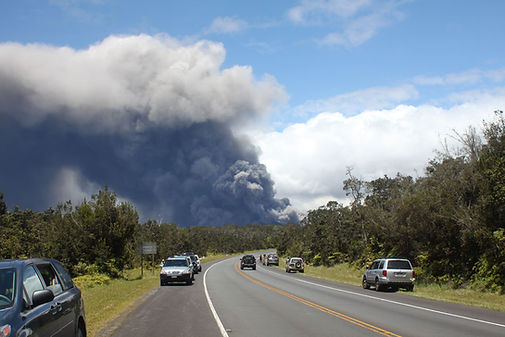
Taken near the entrance of Hawai`i Volcanoes National Park (which is now closed) on May 15, 2018, at 11:28 am.
MORTON GNEISS
Morton, Minnesota
Oldest Rock in the United States — 3.524 billion years old
MORTON GNEISS
Morton, Minnesota
Oldest Rock in the United States — 3.524 billion years old
Kilauea Volcano
10 Questions About the Earth—
and the Geology of North America.
Science — History — Biography
JOHN DAY FOSSIL BEDS, OREGON
Cenozoic Cooling
Oscillating Climate Change

Painted Hills section of the John Day Fossil Beds, Oregon.
A record of the planet's climate for the last few tens of millions of years is on stark display at John Day Fossil Beds National Monument in Oregon. The current geologic era, the Cenozoic, began after the demise of the dinosaurs. That was followed by a sudden heating of the planet known as the Paleocene-Eocene Thermal Maximum, or PETM.
During the ten million years of this intense heat, the planet was sufficiently hot and humid that a dense tropical jungle that included small bananas, palm trees, date and fig trees, existed in what is now north-central Oregon. After another ten million years the planet slowly cooled so that, in north-central Oregon, the climate was a temperate one with wooded areas similar to today's eastern United States with deciduous forests of alder and beech and of elm and oak and with coniferous forests, including the dawn redwood.
The transition in climate can be seen in the Painted Hills Unit at John Day Fossil Beds National Monument. The dark bands are periods of warm tropical forests. The lighter bands are cooler, drier periods when the landscape was covered by deciduous and conifers forests and by newly expanded grasslands. Follow the bands upward. The dark red ones become less pronounced and the lighter ones eventual dominate, indicating a cooling of the planet.


Fossilized leaf imprints of deciduous trees seen along the trails at John Day Fossil Beds National Monument.