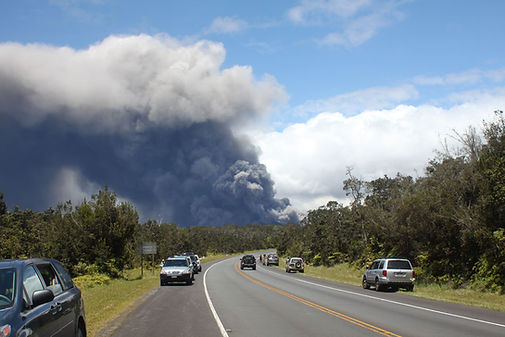
Taken near the entrance of Hawai`i Volcanoes National Park (which is now closed) on May 15, 2018, at 11:28 am.
MORTON GNEISS
Morton, Minnesota
Oldest Rock in the United States — 3.524 billion years old
MORTON GNEISS
Morton, Minnesota
Oldest Rock in the United States — 3.524 billion years old
Kilauea Volcano
10 Questions About the Earth—
and the Geology of North America.
Science — History — Biography
UPHEAVAL DOME, UTAH
Multi-ringed Impact Crater with a Central Uplift
Intense ground shaking — about 180 million years ago
Located in the Island of the Sky District of Canyonlands National Park, close to the seasonal tourist town of Moab, is an impact crater known as Upheaval Dome. Much larger than the more famous Meteor Crater in northeastern Arizona, Upheaval Dome has been deeply eroded: More than a mile of rock has been removed, leaving only a remnant of what once existed. But many features of this impact crater are still visible.

Central uplift and inner ring of Upheaval Dome.
Meteor Crater is a simple, bowl-shaped crater less than a mile in diameter. Upheaval Dome is about six miles across and has a complex structure. There is a central uplift that is surrounded by an inner ring and an outer ring. The rocks of the central uplift are of the Moenkopi Formation (the Chocolate Cliffs of the Grand Staircase). The rocks exposed in the inner ring are of the Wingate Sandstone (Vermilion Cliffs) and those of the outer ring are of the Navajo Sandstone (White Cliffs).

Outer ring of Upheaval Dome looking in the direction opposite to the central uplift.
The strong ground-shaking produced by the impact might be recorded in rocks at nearby Arches National Park. The rocks of the Carmel Formation were then at the surface and represent broad mudflats. The strong shaking may have permanently deformed these mudflats, giving the Carmel Formation its current wavy appearance.

The wavy texture of the Carmel Formation in Arches National Park, 40 miles northeast of Upheaval Dome.